
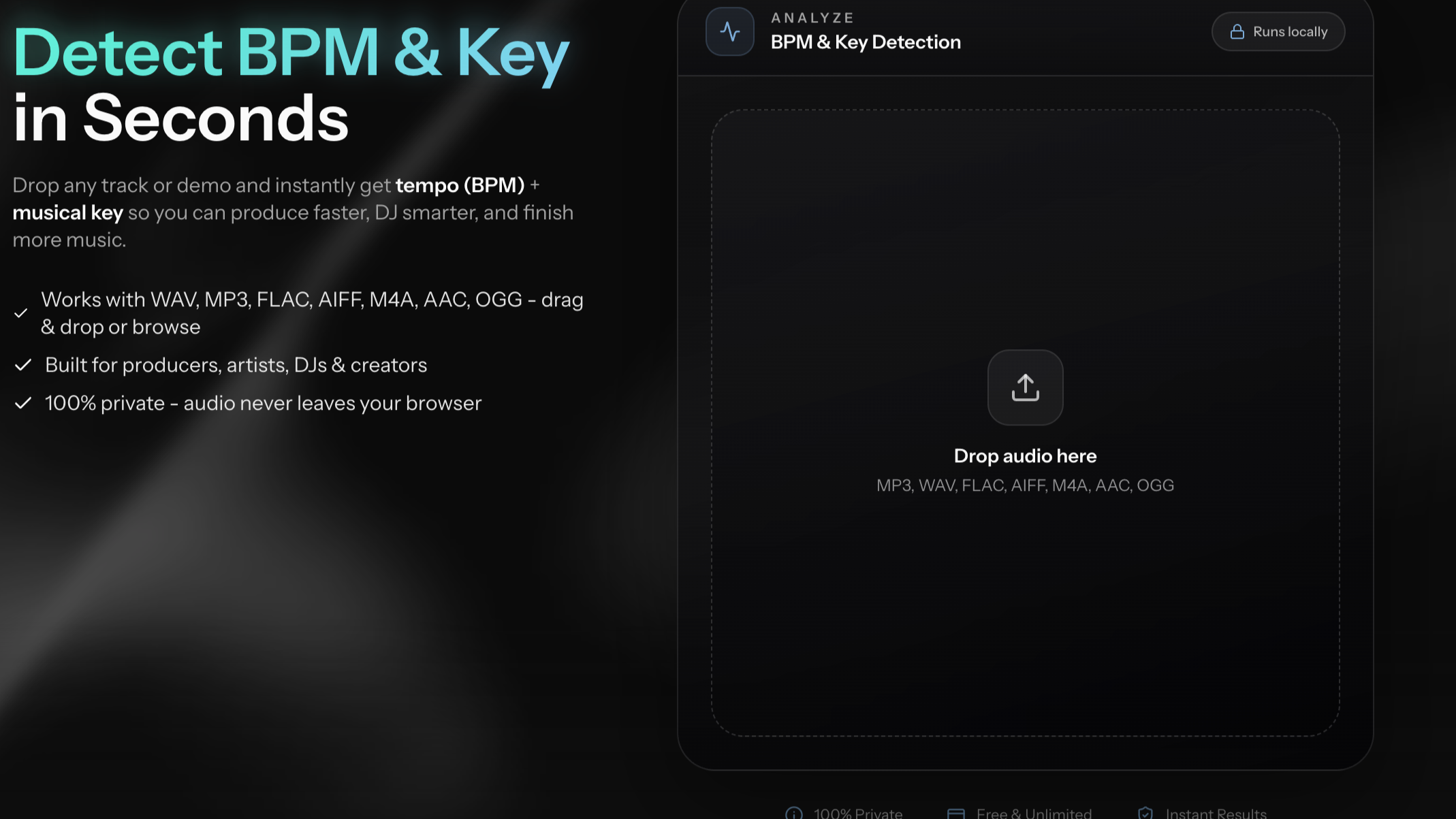
TL;DR: The fastest way to find the key of a song is to drop the audio file into a key detector. The Cryo Mix BPM & Key Detector does this in your browser in seconds, with nothing uploaded to a server. If you want to find the key by ear, listen for the note the melody keeps returning to (the tonic), then test whether a major or minor scale starting on that note feels right against the song. We cover both paths below, plus three other methods.
Finding the key of a song is one of those things that sits in two completely different worlds at once. For some people it is a five-second job: open a tool, drop a file, copy the result, move on. For others it is a question that opens up a whole conversation about tonality, ear training, and how music actually works.
This guide covers both. If you just want the answer, the next section is for you. If you want to actually understand what key detection is doing, keep reading.
I'm a co-founder at Cryo Mix, and we built the free BPM and Key Detector because most of our users hit this exact question every single session. So I'll be upfront: we have a stake in one of the methods I'm about to walk through. The other four work without us.
Why the key of a song matters
Before we get to the methods, a quick reminder of why you'd want this information at all.
If you produce music, the key decides what samples will sit together, where you can place your 808 or bass without it clashing, and what notes a vocalist can actually hit. If you DJ, the key decides what mixes harmonically into what (that is what the Camelot wheel exists for). If you sing or top-line, the key tells you whether the song is in your range before you even open the session. If you mix or master, the key affects how resonances build up in the low mids and how you decide what to cut or leave alone.
In a session, "what key is this?" is usually the second question after "what BPM?". Get it wrong and you spend the next hour fighting decisions you didn't have to make.
What "key" actually means
The key of a song is the pitch center that the music keeps returning to. That center note is called the tonic. Around the tonic, the song uses a specific group of notes (a scale) and the chords built from those notes.
There are two main flavors: major (which tends to sound bright, stable, resolved) and minor (which tends to sound darker, more melancholic, more tense). A song in A minor uses the same set of notes as a song in C major, but the gravitational center is different. Move the center, and the same notes feel like a different piece of music.
That shared-notes detail is also where most key-detection mistakes come from. We'll get there.
The five methods, compared
Method | Speed | Accuracy | Skill needed | Best for |
|---|---|---|---|---|
Online key detector | Seconds | 80 to 95% | None | Producers, DJs, anyone with the audio file |
Finding the tonic by ear | 1 to 5 min | High (depends on ear) | Trained listening | Musicians who want to learn |
Circle of fifths (count sharps/flats) | 2 to 3 min | Medium to High | Reading notation | When you have sheet music or a MIDI file |
Chord progression analysis | 2 to 5 min | High | Music theory | When you can already hear the chords |
Streaming metadata or song databases | Seconds | Mixed | None | Popular released tracks |
Each method has a place. Most working producers I know use the first one by default and one of the others when the result feels off.
Method 1: Use a free online key detector
Drop the audio file into a browser-based key detector and read the result. That is the entire workflow.
The Cryo Mix BPM & Key Detector does this for free, with no signup, no upload, and no credit card. The analysis runs locally in your browser using your device's compute, so the audio file itself never leaves your machine. We built it this way on purpose: a lot of our users analyze unreleased work, demos under NDA, or material headed to a label, and "we promise we won't store it" is a worse answer than "we never had it in the first place."
The tool accepts MP3, WAV, FLAC, AIFF, M4A, AAC, and OGG. Drop a file and you get the BPM, the musical key, and a tempo curve that shows whether the track speeds up, slows down, or stays solid. Most tracks finish analysis in seconds.
How a key detector actually works (the short version)
If you've ever wondered what's happening between "I dropped a file in" and "the result says F minor," here it is.
Almost every modern key detector uses some version of the Krumhansl-Schmuckler algorithm, developed by music cognition researcher Carol Krumhansl. The algorithm has three steps:
Build a pitch class profile. The audio is analyzed and the strength of each of the 12 notes in a chromatic scale (C, C#, D, D#, and so on) is measured over the length of the track. The result is a vector showing how much of each note appears.
Compare against 24 key profiles. Krumhansl and her collaborators ran experiments where listeners rated how well each pitch fit a given key. They derived 24 reference profiles, one for each major and minor key. The original major key values are 6.35, 2.23, 3.48, 2.33, 4.38, 4.09, 2.52, 5.19, 2.39, 3.66, 2.29, and 2.88 across the chromatic scale.
Pick the best match. The detector calculates a correlation coefficient between your track's pitch profile and each of the 24 reference profiles. The highest correlation wins.
That's the foundation. Modern implementations add tempo-aware segmentation, harmonic models, and machine learning on top, but the core logic is still pattern matching against perceptual profiles. The academic paper What's Key for Key? The Krumhansl-Schmuckler Key-Finding Algorithm Reconsidered (Temperley, 1999) is the canonical reference if you want to go deeper.
When key detectors get it wrong
No detector is perfect. The two failures you'll see most often:
Relative major or minor confusion. A minor uses the same seven notes as C major. If your track sits in a gray zone (lots of melodic content without a strong harmonic anchor), the detector might pick the wrong one. Listen to the result: does it feel bright or dark? That usually tells you which one is right.
Modal or modulating songs. A track that changes key, sits in a mode (Dorian, Mixolydian, Phrygian), or leans heavily on borrowed chords can confuse a basic algorithm. The detector will return its best guess, but you might need to verify by ear.
For dense, modern productions in a single clear key, expect accuracy in the 80 to 95% range. For sparse, modal, or live-recorded material, it drops. Always sanity check.
Pro tip: separate stems first
If a detector keeps giving you a result that feels off, try isolating the harmonic content first. Pull out just the instrumental or just the chords with a stem separator, then analyze that isolated stem instead. Drums and aggressive percussion can throw off pitch class profiles because they introduce broadband energy that the algorithm has to work around. Cleaner harmonic content, cleaner result.
Method 2: Find the key by ear
This is the slower method, and it is also the one that makes you a better musician.
The shortcut: find the tonic, then test major or minor against it.
Here's the loop:
Listen to the track all the way through once. Don't try to analyze yet. Just let your ear learn the shape.
Hum along, especially at the end of phrases. Pay attention to the note you land on when the music feels resolved. That note is almost always the tonic. Not always (some songs end on the dominant or a borrowed chord), but as a default it works.
Find that note on a piano or guitar. Match the pitch.
Play a major scale starting on that note. If it sounds like the song, you've found the major key. If it sounds wrong, play a minor scale on the same note. One of them will fit.
Confirm by playing the tonic chord against the song. If the song is in G major, a G major chord should feel like it sits inside the music. If it grates, the key is something else.
A few common traps when doing this by ear:
The melody doesn't always start or end on the tonic. Some songs open on the third or the fifth. Don't assume the first note tells you the key.
The relative minor problem (again). If you find the note "A" and a minor scale fits, it might be A minor. But the song might actually be in C major and just spending a lot of time on the A minor chord. Listen for which note feels like home over the longest stretches.
Watch the bass line. The bass usually outlines the chord progression more clearly than any other instrument. If you can hear the lowest notes, you can usually find the tonic faster.
Doing this even ten times trains your ear to a level where, eventually, you can recognize the key of a song within the first phrase. That's a real skill, and no tool replaces it.
Method 3: Count the sharps and flats (circle of fifths)
If you have sheet music, a MIDI file, or a notation export from your DAW, this is the fastest manual method.
Every key has a fixed number of sharps or flats in its key signature. The circle of fifths is the map:
Sharps | Major key | Relative minor |
|---|---|---|
0 | C major | A minor |
1 (F#) | G major | E minor |
2 (F#, C#) | D major | B minor |
3 (F#, C#, G#) | A major | F# minor |
4 | E major | C# minor |
5 | B major | G# minor |
Flats | Major key | Relative minor |
|---|---|---|
1 (Bb) | F major | D minor |
2 (Bb, Eb) | Bb major | G minor |
3 (Bb, Eb, Ab) | Eb major | C minor |
4 | Ab major | F minor |
5 | Db major | Bb minor |
Count the sharps or flats, look up the row, then decide whether the song is in the major or its relative minor by listening to which feels like home. This was the classic pre-software method and it still works perfectly if you have notation in hand.
Method 4: Analyze the chord progression
If you've already figured out the chords (or you have a chord chart), the key usually announces itself.
In most popular music, the I, IV, and V chords (the "primary" chords) get the most airtime. Look at your chord list:
If the song uses G, C, and D as its main chords, you're in G major (G is the I, C is the IV, D is the V).
If it uses Am, Dm, and E (or E7), you're in A minor.
If the chords are C, F, and G with maybe an A minor sprinkled in, you're in C major.
The chord the song keeps resolving back to (especially at the end of a chorus or verse) is the tonic chord. The key is named after that chord.
This is where music theory pays off, but you don't need a degree. A working knowledge of which chords belong to which keys is enough.
Method 5: Check streaming metadata or song databases
For released, popular songs, sometimes the key has already been catalogued. Spotify and Apple Music both store key data internally (Spotify's Audio Features API exposes it for developers). Sites like Tunebat, Hooktheory, and Songdata.io aggregate this information for major releases, and you can usually find the key of a top 40 song by searching the title.
A few caveats:
This data is often algorithmically detected, not human-verified, so it carries the same accuracy ceiling as any other detector.
It only works for songs that have been indexed.
For your own demos and unreleased work, this method is useless.
I treat song databases as a cross-check rather than a source of truth. If three databases agree on F minor and my detector says F minor, I trust it. If they disagree, I go back to my ears.
After you know the key: what to do with it
Knowing the key is step one. Here's what to do next, depending on what you're working on.
If you're producing: Set your DAW project tempo to the detected BPM, then write melodies and pick samples in the matching scale. Tune your 808 or bass to the tonic. Pick MIDI presets that match the key so your chord progressions don't need transposing later. If you're mixing AI-generated stems from tools like Suno, checking the key first prevents you from layering elements that fight each other.
If you're DJing: Note the Camelot code (most detectors output this alongside the key) and plan transitions using harmonic mixing rules. Songs with the same Camelot number mix smoothly. One step around the wheel works. Plus seven is the classic energy lift.
If you're recording vocals: Confirm the key is in the singer's comfortable range before you commit to a take. If it's a half-step out of reach in either direction, transpose now, not after three vocal sessions.
If you're mixing or mastering: Key matters more here than people think. Resonances in the low mids tend to cluster around the root and its harmonics. Knowing a track is in F means you can predict where buildups will happen around 87 Hz, 175 Hz, 349 Hz, and so on. For more on that mindset, our guide on how to EQ rap vocals walks through how frequency decisions interact with the vocal's pitch range.
Where Cryo Mix fits
A free BPM and key detector is one of those small tools that doesn't seem like much until you use it ten times a week. We built it because the rest of the platform exists for the next stage: when you've got the key, you've got the stems, and you want a clean, loud, release-ready mix and master without paying for a studio day.
If you want the fast path, drop your track into the BPM & Key Detector, then take your stems into Cryo Mix for AI mixing and mastering. If you only need the master, the AI Mastering tool handles that side alone. Everything starts free, no credit card, and you keep all your rights.
A lot of our users are independent artists and bedroom producers who are doing this whole process themselves at home. The tooling should match that reality, not fight it.
FAQ: Finding the key of a song
What is the key of a song?
The key of a song is the pitch center, or tonic, that the music keeps returning to, along with the scale and chord set built around it. Most popular music is in either a major key (brighter, more resolved) or a minor key (darker, more tense). The key is named after the tonic note plus the mode, for example G major or F# minor.
How do I find the key of a song without an instrument?
Use a free online key detector like the Cryo Mix BPM & Key Detector. Drop your audio file in and the analyzer returns the detected key in seconds. If you don't have the audio file, search the song title on a music database like Tunebat or Hooktheory, which list key data for many released tracks.
Are online key detectors accurate?
For most modern, single-key productions, accuracy ranges from about 80 to 95 percent. Accuracy drops for songs that modulate, use modal scales (Dorian, Phrygian, and so on), or have sparse harmonic content. Always cross-check the result against your ears: does the detected key feel like home when you play the tonic chord against the song?
What's the difference between a major and a minor key?
Major and minor keys use different scale patterns starting from the tonic. Major scales sound brighter and more stable. Minor scales sound darker and more tense. A song in C major and a song in A minor use the same seven notes but center on different tonics, which is why key detectors sometimes confuse relative majors and minors.
Can a song be in more than one key?
Yes. Songs that change key are said to modulate. A classic example is a bridge that lifts up a whole step into a new key for emotional impact. Some songs sit between two keys ambiguously. Most key detectors return the dominant key (the one with the strongest correlation), but the song may shift elsewhere in places.
How does Cryo Mix's key detector work?
The Cryo Mix BPM & Key Detector analyzes audio entirely in your browser using local computation. For key detection, it builds a pitch class profile from the waveform and compares it against the 24 major and minor key profiles derived from music perception research. The result is the detected key, alongside BPM and a tempo curve. No audio is uploaded to a server, so it's safe for unreleased and label-bound material.
Why does key matter for mixing and mastering?
Knowing the key helps you predict where resonances and harmonic buildups will sit in the frequency spectrum. Low-mid buildups tend to cluster around the tonic and its overtones. If you're working with stem-based mixing and mastering, key information lets you make better EQ decisions and avoid masking issues between bass, vocals, and harmonic elements.
Cryo Mix is an AI mixing and mastering platform for independent artists, producers, and small labels. Drop stems or a stereo file, shape the sound with Nova (our conversational AI assistant), presets, or 30+ advanced controls, and download a release-ready master. Try it free, no credit card required.